
Why Sheet Music and Music Books Beat YouTube for Learning Music

As a music teacher, I am lucky. I also own and run a music shop. I still sell and have many books, sheet music, exam books etc in the store.
To sit exams, sheet music is essential. So it should be the same whilst learning.
Many customers will buy a guitar as a beginner and when I offer them a selection of learn to play guitar books, their answer is I will learn off you tube.
Now, I have got a you tube channel. I create Videos, however, they are meant to go with the sheet music I give my students.
A video can show you where someone’s fingers go. A good piece of sheet music shows you what the music actually is.
That difference matters. Many players start learning from YouTube because it feels easy, free, and immediate. Search a song, slow the video down, copy the hands, repeat. For the first few days, that can feel productive. But after a while, the gaps appear. The rhythm is guessed. The fingering changes from one video to another. The arrangement does not quite match the original. The learner knows a few shapes, but cannot explain what they are playing.
Sheet music and music books ask for more attention, but they give more back. They teach rhythm, pitch, structure, phrasing, dynamics, and musical independence. They also leave a clear record of what to practise next.
If the goal is to become a better musician, not just copy one performance, it is worth investing in an accurate piece of sheet music and using proper music books as the centre of study.

Sheet music teaches the full language of music
YouTube teaches by imitation. Sheet music teaches by reading, listening, and understanding.
When a piece is written down well, the page tells you far more than which note comes next. It shows:
The exact pitch
The rhythm and note values
The time signature
The key signature
Repeats and endings
Dynamics such as piano, forte, and crescendo
Articulation such as staccato, legato, and accents
Phrasing and expression marks
Tempo guidance
The relationship between parts
Those details are not decoration. They are the music.
A beginner might look at a page of notation and see a puzzle. A stronger player sees instructions, patterns, and musical meaning. The only way to build that skill is to spend time with real notation.
Videos often flatten this process. They can train the eye to follow motion, but they do not always train the ear or the mind to understand pulse, harmony, and form. That is why someone can learn a song from a tutorial and still feel lost when faced with a new piece.
Reading music gives you transfer skills. Once you learn how a dotted rhythm works, you can recognise it in hundreds of pieces. Once you understand key signatures, you stop treating every sharp or flat as a surprise. Once you learn to count properly, rhythm becomes less about guessing and more about control.
That is the kind of progress a screen cannot replace.
YouTube often hides mistakes in plain sight
There is excellent music content on YouTube. Some teachers are careful, skilled, and generous. The problem is not that every video is bad. The problem is that the platform makes it hard to tell the difference.
A confident video can still teach the wrong notes. A popular tutorial can still simplify a song beyond recognition. A flashy performance can still use awkward fingering that causes problems later. A transcription can still miss the bass line, change the harmony, or ignore rhythm.
For a learner, these mistakes are hard to spot.
If a video shows a hand moving quickly across the keys or fretboard, it may look convincing. But the player copying it might never see whether the notation is accurate, whether the rhythm matches the original, or whether the arrangement suits their level.
This matters because bad habits become expensive. A wrong rhythm practised for three weeks does not disappear after one correction. Poor fingering can make a simple passage feel impossible. An inaccurate chord can train the ear to accept a version of the song that never quite sounds right.
With a reliable music book or published score, the material has usually passed through a more careful process. A good edition is edited, engraved, checked, and presented clearly. It gives the learner something stable to return to.
That stability is worth paying for.
A good music book gives you a path, not just a song
One of the biggest weaknesses of video learning is the lack of order. Tutorials usually answer one question: “How do I play this song?” A well-designed music book asks a better question: “What should I learn next?”
A good method book builds skill in stages. It introduces ideas in a sensible order. A beginner piano book might start with hand position, note reading, simple rhythms, and very short pieces. A guitar method might move from open strings to basic chords, then strumming patterns, then simple melodies and reading.
Each step prepares the next one.
That kind of sequence is easy to undervalue. Many learners jump between videos and mistake variety for progress. One day it is a film theme. The next day it is a pop chorus. Then a difficult classical extract. It feels exciting, but the foundation stays uneven.
A music book helps prevent that. It repeats core skills until they become natural. It gives you music that is slightly challenging, not randomly difficult. It also shows what has been covered and what still needs work.
A strong book often includes:
Short exercises with a clear purpose
Pieces that use the skills just introduced
Technical work such as scales, arpeggios, bowing, or finger patterns
Theory in small, useful amounts
Sight-reading practice
Duets or accompaniment parts
Gradual increases in difficulty
This is why teachers still use books. Not because they are old-fashioned, but because they organise learning well.

Accurate sheet music saves time and frustration
A cheap or free score can look tempting. Sometimes it is fine. Sometimes it is wrong in ways that waste hours.
Accuracy matters most when the music is complex, famous, or copyrighted in arranged form. A poor transcription may include missing rhythms, odd chord choices, clumsy page turns, or notes that cannot be played comfortably on the intended instrument. A beginner may blame themselves when the real problem is the material.
Investing in an accurate piece of sheet music gives practice a better starting point.
A quality edition can help with:
Clear layout
The spacing makes the rhythm easier to read, and page turns are less awkward.
Reliable notes
The pitches and harmonies match the intended piece or arrangement.
Useful fingering
Good fingering gives the hand a practical route through difficult passages.
Proper level
A graded arrangement fits the player’s current ability better than a random online version.
Musical detail
Expression marks guide interpretation instead of leaving everything to guesswork.
For classical music, different editions may offer different fingerings or editorial suggestions, but serious editions still give a trustworthy base. For popular music, an authorised or well-reviewed arrangement is usually safer than an anonymous upload.
The point is simple: poor sheet music makes practice harder than it needs to be.
A player might struggle for days with a bar that is badly notated. They might learn a version of a song that sounds thin because the chords were copied carelessly. They might face page turns that interrupt the flow because the layout was an afterthought.
Good materials remove many of those distractions. They let the player focus on music.
Printed music keeps practice slower and deeper
YouTube is designed to keep people watching. Music practice needs almost the opposite: attention, repetition, and patience.
A printed page does not autoplay. It does not suggest five unrelated videos. It does not reward skipping the hard bar. It sits there quietly and shows exactly what needs work.
That makes a real difference.
When practising from sheet music, a musician can circle a hard rhythm, write in counting, mark a breath, or note a better fingering. They can break one bar into small parts. They can compare the left hand and right hand. They can look ahead and notice that the same pattern returns later.
This kind of work is not glamorous, but it builds skill.
Videos can make learners rush. The tutorial moves on, the performer plays at full speed, and the viewer feels pressure to keep up. Even with playback speed controls, the experience often remains passive. The learner watches more than they practise.
With a book, practice becomes active. The page asks questions:
Can I count this rhythm without playing?
Can I name these notes?
Can I clap the pattern first?
Can I play this slowly without stopping?
Can I shape the phrase, not just hit the notes?
Those questions develop musicianship.
Music books make it easier to work with a teacher
A teacher can do a lot more with a clear score than with a vague memory of a video.
If a student brings printed music to a lesson, teacher and student can look at the same bar, mark the same fingering, and solve the same problem. The teacher can write reminders directly on the page. Next week, they can check whether those notes helped.
That shared reference saves time.
It also makes feedback more exact. Instead of saying, “The bit after the chorus is wrong,” the teacher can say, “Look at bar 17. The quavers need to stay even, and the left-hand accent is too heavy.” That level of detail is hard to match when the source is a video tutorial with no reliable score.
Sheet music also helps parents, accompanists, ensemble leaders, and exam teachers. Everyone can see the piece. Everyone can talk about the same musical details.
For anyone preparing for graded exams, auditions, school performances, church music, theatre work, or ensemble playing, reading from music is not optional for long. It is part of how musicians communicate.
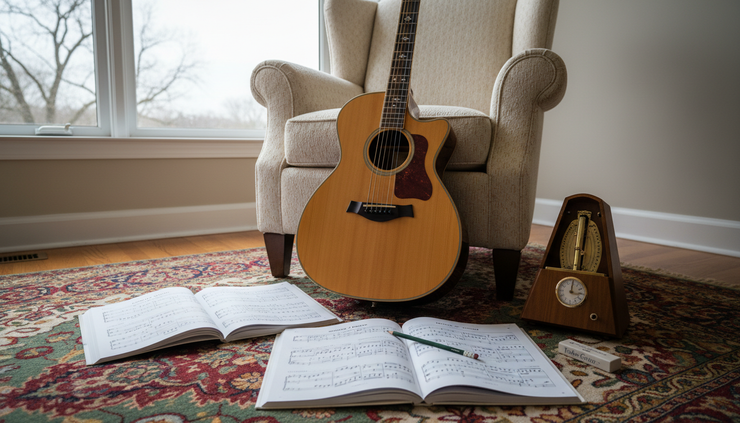
YouTube can support learning, but it should not lead it
There is still a place for video. A good recording can help a player hear the style of a piece. A teacher’s demonstration can clarify hand position, bow movement, breath control, or strumming feel. A performance video can inspire practice.
The key is to use video as a supplement, not as the main source.
A healthy order looks like this:
Start with an accurate score or a trusted music book.
Read the notes, rhythm, and markings.
Practise slowly with a clear plan.
Listen to a recording after you have studied the page.
Use video only to answer specific questions or compare interpretations.
That order keeps the music in charge. It also stops the learner from becoming dependent on visual copying.
A player who always learns from videos may struggle when no tutorial exists. A player who reads well can discover music from any printed source, including older collections, ensemble parts, exam pieces, hymn books, jazz lead sheets, and new compositions.
That independence is one of the great rewards of learning to read.
How to choose sheet music that is worth buying
Not every printed score is equally useful. Some editions are excellent. Some are cluttered, inaccurate, or poorly suited to the player.
Before buying, look for a few signs of quality.
Check the level
The arrangement should match current ability. A piece that is far too hard can damage confidence. A piece that is far too easy may not teach much. Graded books are useful because they place music in a clear learning order.
Look at the layout
The page should be easy to read. Notes should not feel cramped. Repeats, endings, chord symbols, and lyrics should be clear. If the music needs page turns, they should make sense where possible.
Choose the right arrangement
A beginner piano version, a full classical score, a guitar tab edition, and a vocal arrangement may all carry the same song title, but they are not the same product. Check the instrument, level, key, and format before buying.
Prefer reputable publishers and editions
For well-known classical works, choose recognised editions where possible. For popular songs, look for authorised or carefully reviewed arrangements. For method books, choose ones commonly used by teachers and suited to the instrument.
Avoid relying on unverified uploads
Free scores can be useful, especially for public domain music, but check them carefully. If something sounds wrong, looks awkward, or lacks basic markings, it may not be worth your practice time.
Use a pencil
A clean score is nice. A useful score is better. Mark fingerings, breathing, counting, shifts, bowings, dynamics, and practice dates. Keep it neat, but make the page work for you.
What better practice looks like with a score
Good materials only help if they are used well. A music book is not magic. It needs slow, honest practice.
A simple practice routine might look like this:
Read through the page before playing.
Clap or count the rhythm.
Name difficult notes or chords.
Practise hands separately if needed.
Work in small sections.
Use a metronome at a slow tempo.
Mark mistakes and solve them.
Play through only after the details are steadier.
This is less entertaining than watching another tutorial, but it produces stronger results.
The aim is not to finish the page as quickly as possible. The aim is to understand it so well that the music becomes secure. That means rhythm, tone, touch, articulation, and expression all receive attention.
A video can show the surface of performance. A score can train the habits underneath it.
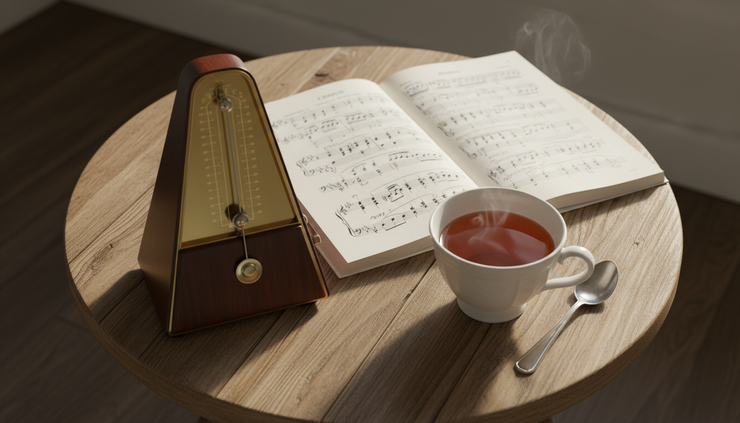
The page builds musicians who can stand on their own
YouTube can be useful, but it should not be the foundation. Too much video learning trains dependence. It encourages copying without always understanding. It can hide mistakes, skip theory, and replace slow practice with constant watching.
Sheet music and music books do something better. They give structure. They develop reading. They teach rhythm accurately. They make practice visible. They help teachers give clearer feedback. They open the door to music that has no tutorial at all.
The next time a piece feels exciting enough to learn, resist the urge to search for the quickest video. Find a trustworthy score. Buy the right music book. Choose an arrangement that suits the instrument and level. Put it on the stand, pick up a pencil, and work through it properly.
That investment is small compared with the hours spent practising. More than that, it shows respect for the music and for the person learning it.
Of course this is just my opinion.
Stuart Lewis
Spiders Music School
Spider Music Ltd

Comments